Water, Rivers & Resilience.
A federated knowledge commons connecting hydrology, traditional water wisdom, expert memory, history, field evidence and emerging technology.
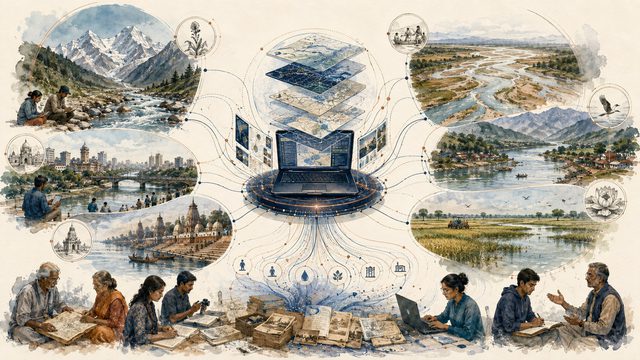
Pani Ki Kahani
Pani Ki Kahani can serve as the discovery and methods layer across water research: traditional systems, community monitoring, urban hydrology, groundwater, river-floodplain relationships and responsible use of sensors and AI.
Visit Pani Ki Kahani ↗AI should index the archive, not rewrite history.
Use AI for search, transcription, translation, entity extraction and map linking. Keep every historical claim, expert opinion and contested interpretation attached to its source, date and context.
Independent identities. Shared knowledge standards.
The Foundation supports and preserves a pro-bono ecosystem of river knowledge sites so expert and public knowledge can accumulate in one discoverable system without erasing basin-specific context.
Umbrella water knowledge, methods and cross-cutting research.
Open knowledge node ↗Bagmati RiverRiver history, flood and embankment debates, basin knowledge.
Open knowledge node ↗Brahmaputra RiverCivilizational, cultural, basin and research material.
Open knowledge node ↗Burhi GandakGeography, flood/drought history and research documentation.
Open knowledge node ↗Gomti RiverStudy-group and knowledge-base orientation around river restoration.
Open knowledge node ↗Koshi RiverDeep flood, drought, embankment, agriculture and lived-memory archive.
Open knowledge node ↗Mahananda RiverRiver history, geography and basin-specific knowledge.
Open knowledge node ↗The GangesGanga history, culture, ecology, conservation and expert contribution.
Open knowledge node ↗How every river archive can compound.
Source, tributaries, floodplain, flow, sediment, groundwater interface.
Habitats, water quality, embankments, barrages, canals, urban interfaces.
Flood/drought histories, agriculture, fisheries, navigation, oral histories.
Government records, expert archives, dates, corrections and competing views.