Circular & Distributed Economy.
Study how cities can circulate materials, food, skills and economic value closer to where people live—without assuming that local automatically means sustainable.
Twice Told
Give materials a second story. Twice Told is the Foundation’s practical lens on recyclable and reusable material economies: repair, redesign, upcycling, maker livelihoods and transparent local value creation.
Research can test condition assessment, maker matching, quality standards, logistics, pricing, material diversion and the economics of keeping useful materials in circulation.
Visit Twice Told ↗Distributed Urban Food Systems
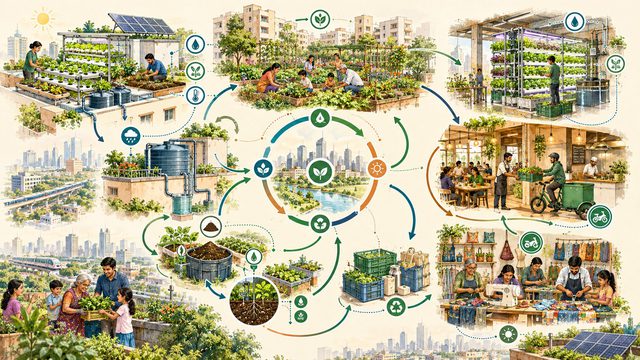
Urban farming becomes strategically interesting when it stops being treated as a hobby garden and starts behaving like distributed infrastructure: many small sites, shared professional operations, common data, nearby demand and coordinated logistics.
Start where proximity matters—leafy greens, herbs, microgreens, seedlings and selected vegetables—not with the claim that rooftops should replace regional staple agriculture.
Share the farming burden, not just the land.
A housing society, school, café or institution provides usable space and demand. A specialist shared operator manages production across many sites, reducing the need for every location to recreate agronomy, tools, labour and logistics.
Smart farming layer
Moisture, temperature and microclimate sensing; EC/pH where justified; crop calendars; human-reviewed plant health; shared yield/water/labour data.
Shared operations
Nursery, tools, composting, reusable crates, selected cold-chain capacity and trained growers distributed across a neighbourhood cluster.
Local logistics
Nearby cafés, kitchens, schools and households create visible demand; cargo cycles or small EVs batch movement inside a short service radius.
One local operating system.
Local is a hypothesis—not a sustainability label.
Krishadri should compare cost, energy, water, yield, labour, waste, transport, resilience and social value. The question is not “Can this be local?” but “At what scale and under what conditions does local production outperform a longer supply chain?”